
Transformer Losses and Efficiency: How to Reduce Lifecycle Costs in Industrial and Utility Projects

Transformers are among the most efficient assets in an electrical system, but even small losses matter when equipment operates continuously for years. For industrial plants, utilities, mining operations, renewable energy projects and large commercial facilities, transformer selection should therefore consider more than purchase price.
The key question is not simply, “What does the transformer cost to buy?” It is, “What will this transformer cost to own and operate over its service life?”
Understanding transformer losses and efficiency helps engineers, EPC contractors and procurement teams compare designs more accurately. No-load losses, load losses, operating profile, temperature, cooling, maintenance and energy price can all influence lifecycle cost.
In Australia, covered distribution transformers are regulated under the Greenhouse and Energy Minimum Standards framework, with minimum efficiency requirements applying to relevant products.
Why Transformer Efficiency Matters
A transformer may remain energised 24 hours a day even when the connected load is relatively low. Energy loss therefore becomes an ongoing operating cost rather than a one-time design consideration.
Two transformers with the same kVA or MVA rating can have different loss characteristics. One may have a lower purchase price but higher no-load or load losses. Another may cost more initially but consume less energy throughout its operating life.
Over a long asset life, the difference can materially affect total cost of ownership.
IEC TS 60076-20 provides methods for evaluating the energy performance of transformers, while IEC 60076-19-1 addresses uncertainty in measurements of no-load and load losses during routine transformer tests.
For procurement teams, efficiency should therefore be treated as a commercial parameter as well as a technical one.
Understanding No-Load Losses
No-load losses, also known as core or iron losses, occur whenever the transformer is energised, even when it is supplying little or no load.
They are primarily associated with the transformer magnetic core and include hysteresis and eddy-current losses. Australian Government technical material describes no-load losses as essentially fixed losses that are present whenever the primary winding is connected to the grid.
This makes no-load loss particularly important for transformers that remain energised continuously but operate at relatively low average utilisation.
Typical examples can include distribution substations, standby infrastructure, seasonal facilities and oversized transformers.
A procurement team comparing transformer offers should therefore request guaranteed no-load loss values rather than evaluating equipment only by capacity and initial price.
Understanding Load Losses
Load losses, sometimes referred to as copper or winding losses, occur as electrical current flows through the transformer.
They include winding resistance losses and additional stray losses. The resistive component follows the I²R relationship, meaning losses increase significantly as current increases. Australian Government transformer efficiency analysis similarly distinguishes load losses from fixed core losses and shows that load losses become increasingly important as transformer loading rises.
This has an important commercial implication.
An industrial transformer operating near its rated capacity for many hours per day has a very different lifecycle loss profile from a transformer supplying a lightly loaded network.
The right question is therefore not simply:
“Which transformer has the lowest losses?”
It should be:
“Which transformer has the best loss characteristics for this project's actual operating profile?”
Efficiency Depends on Loading Profile
Transformer efficiency changes with loading because no-load and load losses behave differently.
At low loading, fixed core losses represent a larger proportion of the energy being transferred. As load increases, no-load loss remains relatively stable while current-dependent losses increase.
Government transformer efficiency analysis notes that peak efficiency occurs around the point where load losses and no-load losses are equal.
This is why simply oversizing a transformer does not automatically improve efficiency.
A much larger transformer may provide additional capacity, but if it spends most of its service life operating at a very low percentage of its rating, the project may be carrying unnecessary capital cost and continuous no-load losses.
Leistung Energie's Distribution Transformer Sizing Guide similarly recommends balancing capacity, future growth, efficiency and lifecycle cost rather than selecting transformer capacity from connected load alone.
Use the Real Load Profile, Not Only Peak Demand
Maximum demand is important, but peak demand alone does not provide enough information for a lifecycle efficiency assessment.
Engineers should understand how the transformer will operate throughout the day, week and year.
Consider two facilities.
One transformer reaches 90% loading for a short daily peak but operates around 30–40% for most of the day.
Another transformer operates continuously at 75–85% loading.
Although their peak ratings may look similar, their annual loss profiles will be very different.
For lifecycle evaluation, consider average loading, peak demand, duration of high-load periods, seasonal variation, future expansion, redundancy philosophy and annual energised hours.
For industrial sites, operating schedules, motor loads, production expansion, VSDs and standby modes can also materially change transformer utilisation.
Temperature Affects Losses and Transformer Life
Temperature is closely linked to transformer performance.
As conductor temperature increases, winding resistance rises, increasing resistive losses. At the same time, higher operating temperature affects insulation ageing and therefore long-term transformer life.
IEC 60076-7 provides guidance for mineral-oil-immersed transformers from the perspective of loading, ambient temperature, operating temperature and thermal ageing.
For dry-type transformers, IEC 60076-12 provides guidance for estimating insulation ageing and lifetime consumption as a function of temperature, loading and operating time.
For Australian projects, this makes site conditions particularly important.
Transformer specifications should consider ambient temperature, ventilation, enclosure conditions and cooling performance, especially for mining sites, outdoor substations, compact kiosks and enclosed transformer rooms.
A transformer with attractive factory loss figures may not deliver the expected lifecycle performance if it operates continuously under unsuitable thermal conditions.
Cooling and Efficiency Should Be Evaluated Together
Transformer losses ultimately become heat, which must be dissipated while keeping winding and insulation temperatures within acceptable operating limits.
Cooling should therefore be considered as part of the efficiency evaluation.
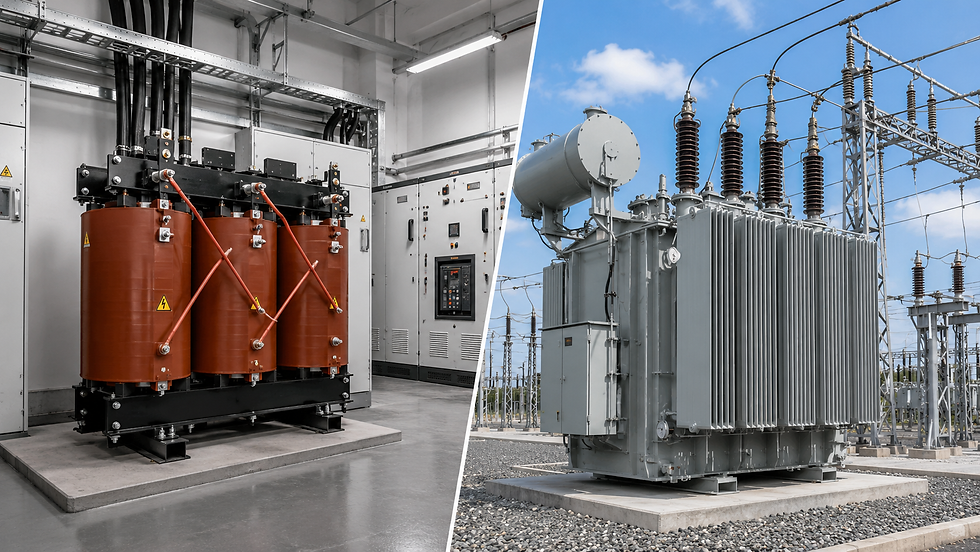
Oil-immersed transformers may use natural or forced cooling arrangements depending on rating and application, while dry-type transformers use natural or forced air circulation. Leistung's transformer content also identifies cooling and installation environment as key considerations when selecting transformer capacity and configuration.
Where forced cooling equipment is required, auxiliary energy consumption should also be considered.
The project should therefore evaluate the transformer as a complete operating system, not simply compare one headline efficiency percentage.
Why Purchase Price Alone Can Be Misleading
Transformer procurement is often competitive, making initial purchase price one of the most visible commercial metrics.
However, purchase price represents only one component of lifecycle cost.
A more useful conceptual evaluation is:
Lifecycle Cost = Purchase Cost + Energy Loss Cost + Maintenance Cost + Reliability/Downtime Cost + End-of-Life Cost
Energy loss cost can be estimated using guaranteed transformer losses, expected loading profile, annual operating hours, electricity value and project evaluation period.
Consider two compliant transformer offers.
Transformer A has the lower purchase price but higher annual losses.
Transformer B costs more initially but has lower guaranteed no-load and load losses.
If the energy savings from Transformer B accumulate over many years, the higher upfront cost may be recovered through lower operating expenditure.
This is particularly important for continuously energised transformers and high-utilisation industrial or utility assets.
The goal is not to select the most expensive transformer. It is to identify the option that delivers the best overall technical and commercial result.
Australian Efficiency and Compliance Considerations
Australia applies Minimum Energy Performance Standards to covered distribution transformers under the GEMS framework.
The Australian Government Energy Rating program states that minimum efficiency levels for relevant distribution transformer categories are defined at 50% of rated load, with requirements referenced to AS 2374.1.2-2003.
However, minimum compliance should be treated as the starting point rather than the entire procurement strategy.
Two compliant transformers may still differ in:
Evaluation Area | Why It Matters |
No-load losses | Affects continuous energisation cost |
Load losses | Important under higher utilisation |
Temperature rise | Influences thermal performance |
Cooling method | Affects capacity and auxiliary requirements |
Impedance | Influences fault level and voltage performance |
Noise | Important for sensitive installations |
Maintenance | Influences operating expenditure |
Lifecycle support | Affects long-term asset availability |
Procurement documents should therefore request guaranteed losses in addition to basic compliance evidence.
What to Request From Transformer Suppliers
A technically useful quotation should allow direct comparison between suppliers.
Procurement Item | What to Request |
No-load loss | Guaranteed watts or kW |
Load loss | Guaranteed watts or kW at specified reference condition |
Efficiency | Values at agreed loading points |
Temperature rise | Guaranteed limits |
Cooling | Cooling designation and auxiliary requirements |
Impedance | Guaranteed percentage impedance |
Standards | Applicable IEC, AS/NZS and GEMS requirements |
Testing | Routine tests and FAT requirements |
Loss tolerances | Applicable guaranteed tolerances |
Lifecycle support | Spares, service and technical assistance |
IEC 60076 standards cover key aspects of transformer specification and testing, while IEC 60076-19-1 specifically addresses uncertainty in no-load and load-loss measurements.
This makes verified test documentation important when efficiency is part of the commercial evaluation.
Evaluate Efficiency Together With Transformer Sizing
Efficiency and transformer sizing should never be treated independently.
An undersized transformer may operate close to its thermal limits, reducing operating margin.
An excessively oversized transformer may increase equipment and installation cost while spending most of its life at low utilisation and continuously carrying no-load losses.
The target is a transformer rating that accommodates expected demand, credible peaks and justified future growth without unnecessary overcapacity.
Leistung Energie's transformer sizing guidance recommends considering load demand, power factor, voltage, expansion, cooling, installation environment and efficiency before selecting the final transformer rating.
Industrial Projects: Focus on Load and Thermal Duty
Industrial facilities often have sustained electrical demand from motors, pumps, conveyors, compressors, process equipment and power-electronic loads.
In these applications, transformer evaluation should pay particular attention to load losses, temperature rise, loading profile, cooling performance and reliability.
Harmonic-rich loads can also contribute to additional heating, making actual site load characteristics important when evaluating transformer performance. Australian Government transformer analysis notes that harmonic content can influence transformer loss mechanisms.
For industrial projects, transformer efficiency should therefore be considered together with switchgear, cables, protection and power quality.
Utility Projects: Think in Decades, Not Tender Cycles
Utility transformers are long-life network assets.
Even a relatively small difference in annual energy loss can accumulate over many operating years and across a large transformer fleet.
Utility procurement should therefore compare guaranteed losses alongside expected load growth, utilisation, maintainability, monitoring requirements, reliability and lifecycle support.
A lower tender price can become poor value if the network continues paying for higher losses throughout the asset's operating life.
Transformer Lifecycle Cost Checklist
Before placing an order, confirm the expected loading profile, guaranteed no-load losses, guaranteed load losses, efficiency at relevant loading points, annual energised hours, ambient conditions, cooling arrangement, future growth allowance, energy cost assumptions, applicable standards, testing requirements, maintenance strategy and supplier lifecycle support.
This information gives engineering and commercial teams a common basis for comparing transformer offers.
Conclusion
Transformer losses and efficiency directly affect lifecycle cost in industrial and utility projects.
No-load losses matter because they continue whenever the transformer remains energised. Load losses become increasingly important as current and utilisation rise. Temperature, cooling and loading profile influence both efficiency and long-term asset performance.
For Australian distribution transformer projects, GEMS efficiency requirements provide an important compliance baseline, but effective procurement should go further by comparing guaranteed losses and actual operating duty.
The best transformer is therefore not necessarily the cheapest unit or the transformer with the highest nameplate capacity.
It is the transformer that provides the right balance of capacity, efficiency, thermal performance, reliability and lifecycle cost for the actual project.
Talk to Leistung Energie About Transformer Efficiency
Planning an industrial, utility, mining, renewable energy or infrastructure transformer project?
Leistung Energie Australia provides power transformers and dry-type and oil-type distribution transformer solutions for a range of demanding applications. Leistung's current distribution transformer portfolio includes both oil-type and dry-type categories.
Contact Leistung Energie to discuss your transformer rating, guaranteed losses, loading profile, cooling requirements, efficiency targets and lifecycle support before finalising the procurement specification.


Comments